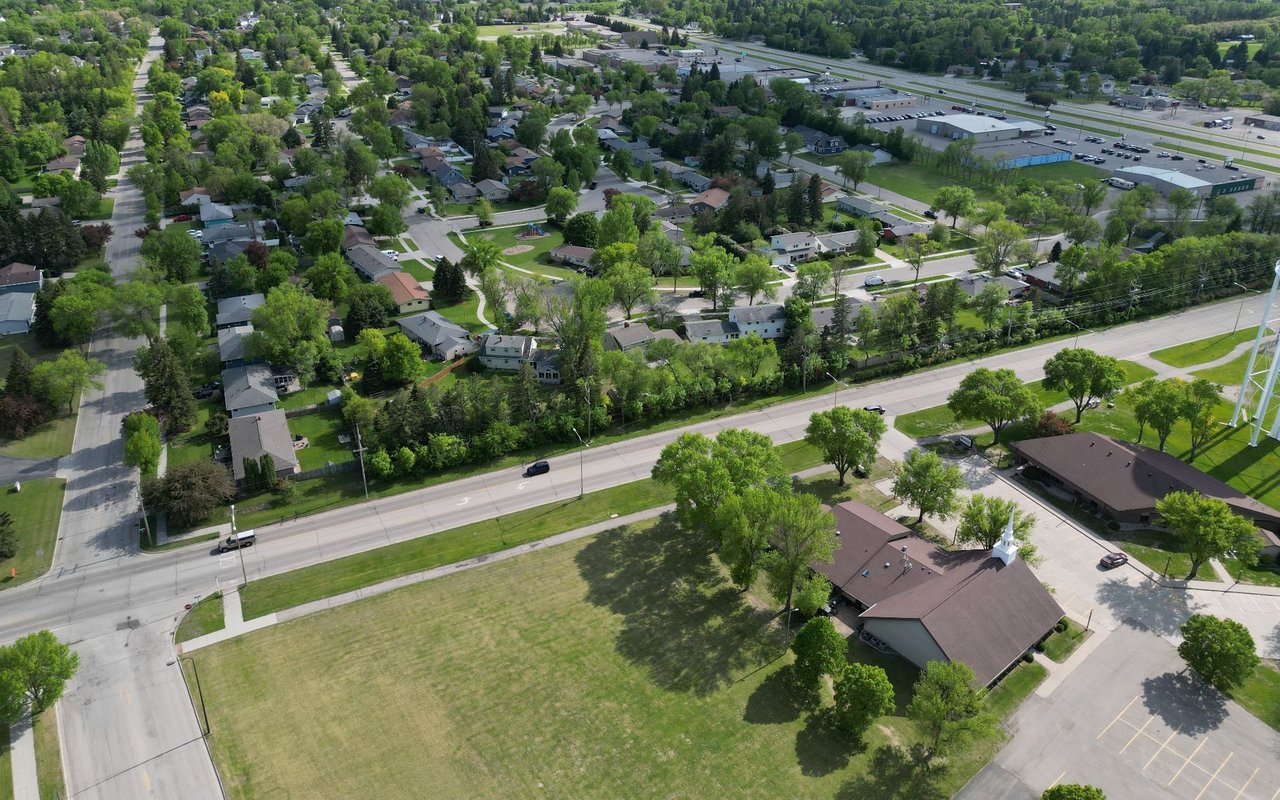
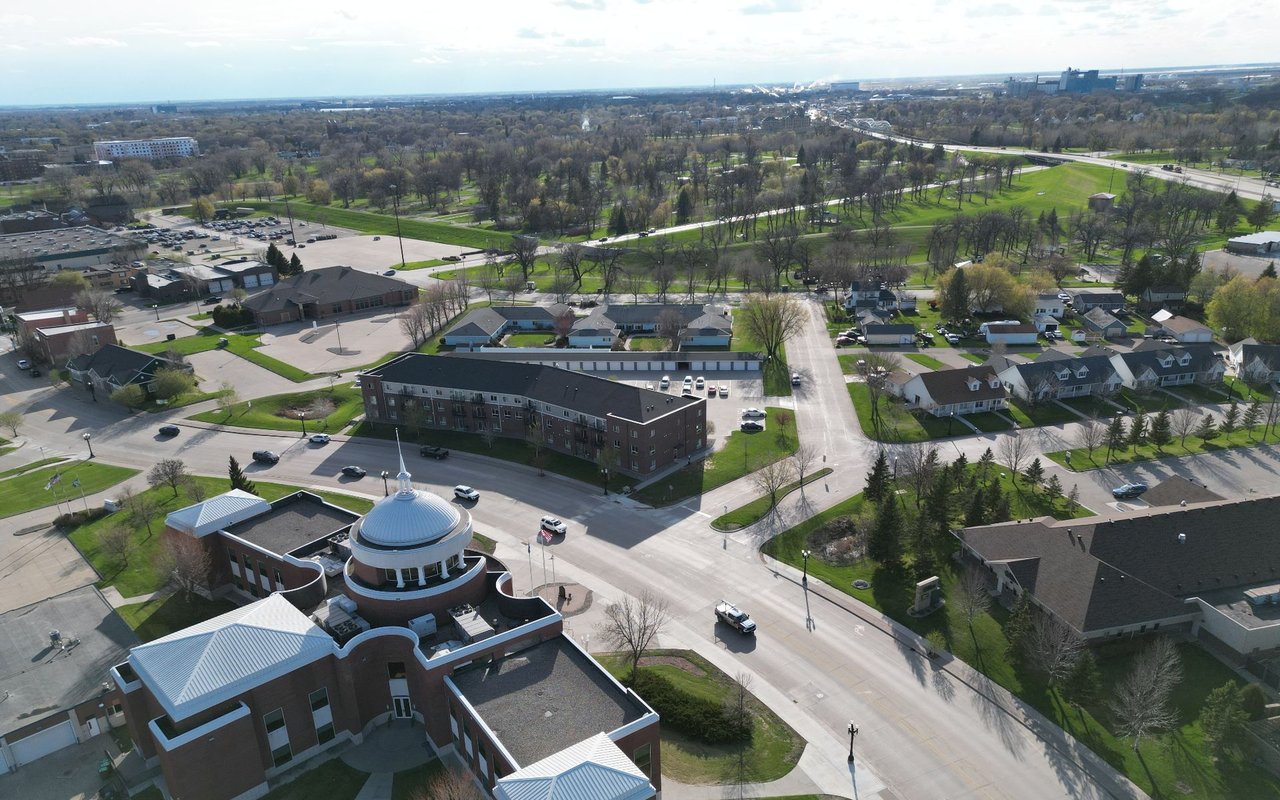
61,346 people live in Grand Forks, where the median age is 30.9 and the average individual income is $39,502. Data provided by the U.S. Census Bureau.
Total Population
Median Age
Population Density Population Density This is the number of people per square mile in a neighborhood.
Average individual Income
Grand Forks is a city of roughly 60,000 sitting on the Red River at the North Dakota-Minnesota line, and its character comes from three things that don't usually coexist in a place this size: a major research university, a regional healthcare system, and an Air Force base. That combination produces a housing market with unusually steady demand and an unusually broad buyer pool.
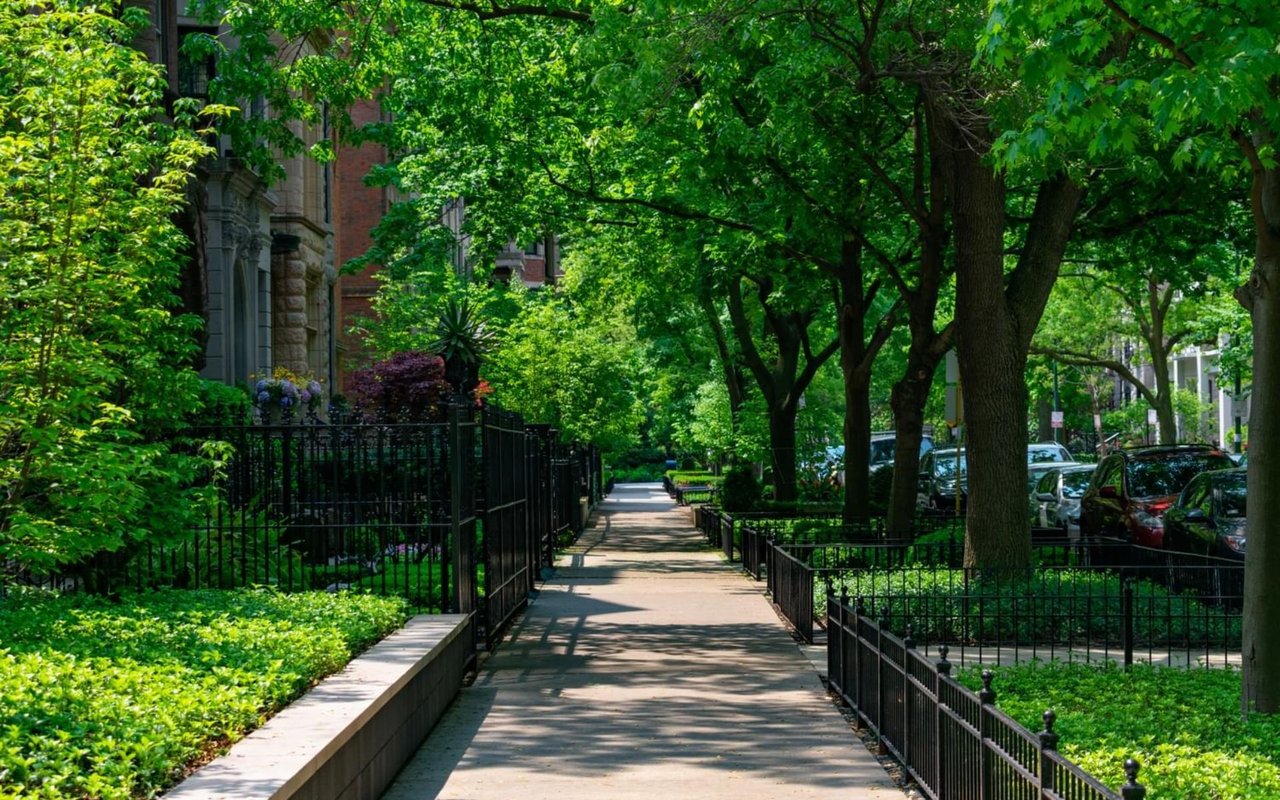
Geographically, the city divides into patterns worth knowing before you shop. Downtown and the Near South Side — the historic corridor along Reeves Drive and Belmont Road — hold the city's oldest and most architecturally distinctive homes on tree-canopied streets within walking distance of restaurants and the Greenway. South Grand Forks, pushing toward 32nd Avenue and beyond, is where new construction happens: planned subdivisions, three-car heated garages, golf course communities. The UND corridor functions as the city's rental core.
Who ends up here: UND faculty and staff, physicians and nurses tied to Altru Health System, Air Force personnel and contractors, and multi-generational Grand Forks families who own the historic stock and don't part with it easily. Add students, and you get a rental market with genuine depth.
The practical appeal is straightforward. Cost of living runs about 9% below the national average, the housing stock spans 1900s Queen Anne to brand-new patio homes, and you can cross town in fifteen minutes. What you trade is winter — real winter — and a market where the historic inventory you probably want is tighter than the new-build inventory you probably weren't shopping for.
The site was called Les Grandes Fourches by French fur traders working the confluence of the Red and Red Lake rivers — the "grand forks" the city still takes its name from. It was officially platted in 1875 by steamboat captain Alexander Griggs, whose river trade made the location commercially viable in the first place.
As the city grew south from downtown along the Red, the Near South Side emerged in the late 19th and early 20th centuries as Grand Forks' most fashionable address. Civic leaders, rail executives, and prosperous merchants built stately homes along tree-lined streets like Reeves Drive in Queen Anne, Colonial Revival, and Tudor Revival styles. Those houses are still standing and still trading, and they remain the top of the city's character market.
The defining modern event was the Red River Flood of 1997, which inundated much of Grand Forks and reshaped how the city relates to its river. What followed matters enormously to anyone buying here today: extensive flood mitigation, permanent floodwall infrastructure, and the creation of the Greater Grand Forks Greenway — a 2,200-acre linear park along the river. The Greenway did two things at once. It protected the historic neighborhoods from repeating 1997, and it handed those same neighborhoods twenty-plus miles of trail and parkland out their back door.
That's the essential historical fact for a buyer: the flood is the reason the old houses survived intact and the reason the neighborhood now has one of the best park systems in the Upper Midwest.
Grand Forks runs as a balanced, moderately competitive market — not a frenzy, but not slow. The citywide median sits near $300,000, and correctly priced homes generally reach pending status within 15 to 30 days. Most transactions close at or slightly below list, which is the signature of a market that rewards strong offers on turn-key property without punishing buyers who need to negotiate.
Where it gets interesting is the split between the two halves of the market.
Historic central and Near South Side inventory stays tight. The neighborhood's proximity to downtown and UND, combined with a fixed supply of pre-war homes, means well-maintained properties move. Expect roughly $300,000 to $370,000 for a solid historic or mid-century home in the corridor, with the premium historic streets — Reeves Drive in particular — pushing $500,000 and above. The full range spans about $230,000 for a mid-century starter up to $650,000+ for a fully renovated historic estate.
South Grand Forks is the supply valve. New construction here starts in the mid-$300,000s for patio homes and townhomes and runs $450,000 to over $700,000 for fully custom single-family, depending on lot and finish tier.
The dynamic worth internalizing: if you want character and walkability, you're competing in a constrained market and should be prepared to move quickly. If you want new and low-maintenance, you have far more leverage and more time. Those are different negotiating postures, and buyers who apply the wrong one to the wrong side of town tend to struggle.
The south side is the city's primary engine for new residential development, and virtually all meaningful new-build activity happens there.
What's being built: planned subdivisions with modern split-levels, expansive two-story designs, and maintenance-free townhome communities — several of them organized around golf, most notably the King's Walk area.
Active regional builders include Affinity Builders, Applegren Construction, and Black Point Building Group, covering both custom and production work across the price spectrum.
Here's what a buyer should actually expect from a Grand Forks new build:
Move-in-ready patio homes and townhomes typically start in the mid-$300,000s. Fully custom single-family regularly runs $450,000 to over $700,000, driven mostly by lot size and finish level. Standard features in this market include open-concept plans, high-efficiency HVAC, and — this is not a luxury item in North Dakota — an attached three-car heated garage. If a new build in this price range doesn't have heated garage space, that's a meaningful omission, not a minor spec difference.
The line item that catches people: special assessments. New city lots carry infrastructure taxes for streets, water mains, and sidewalks, and on freshly developed south-side parcels those certified balances are substantially higher than anything you'll find in the historic core. A new build's builder price is not its carrying cost. Ask for the certified and uncertified special assessment balances on the specific lot before you sign anything.
Grand Forks is a genuinely strong rental market for its size, and the reason is structural rather than cyclical: UND, Altru Health System, and the Air Force base generate tenant demand that doesn't depend on the local economy having a good year.
The Near South Side and adjacent UND corridor are the core rental hubs. Investors target this zone for a tenant pool of students, healthcare workers, and young professionals who want central proximity.
Yields. Traditional long-term rentals here average cap rates in the 6% to 8.5% range. Small multi-family near campus — duplexes and fourplexes — often produce gross rental yields of 8% to 10%, particularly when operated on a per-bedroom student rental model. Those are numbers that hold up against much larger markets, and they're the main reason out-of-area investors look at Grand Forks at all.
Cash flow versus appreciation. These pull in opposite directions and you should pick deliberately. South Grand Forks offers stronger long-term equity growth through master-planned appreciation. The central and Near South Side district delivers stronger immediate cash flow, because entry prices are lower relative to achievable rents. You are choosing between the two, not getting both.
Value-add and flips. This is where Grand Forks separates from newer suburban markets that have no dated inventory to work with. Classic early-20th-century homes in the central corridor create real repositioning opportunity. Investors regularly acquire distressed single-family structures in the $160,000 to $220,000 range and remodel layout and mechanicals, or convert basements into compliant secondary units — building solid equity margins for resale or long-term refinance.
Two cautions from experience. Basement conversions need to be compliant — egress, ceiling height, and city code, not just finished. And student-rental economics are excellent until they aren't; per-bedroom strategies carry higher turnover and higher management intensity than the cap rate alone suggests.
The buying process here depends heavily on which submarket you're in, but the central historic corridor is where it gets most competitive.
Competitiveness. Moderate to high in the Near South Side. You'll compete with long-term residents, UND faculty, and local professionals for a limited supply of well-maintained historic homes. Move-in-ready property priced correctly under $400,000 sees fast activity, and well-kept historic homes typically go under contract in 15 to 30 days. New construction on the south side is a calmer, more negotiable process.
Property types. In the central corridor: early-20th-century Craftsman bungalows, Queen Anne and Colonial Revival single-family homes, and mid-century split-levels along the western perimeter. South side: modern split-levels, two-stories, patio homes, and townhomes.
Due diligence that actually matters here:
A practical note for out-of-state buyers, particularly those relocating for UND or the Air Force base: winter readiness is a real inspection category here, not a formality. Window condition, insulation, and furnace or boiler age affect both comfort and monthly cost in a climate that tests all three.
Sellers in the central corridor hold genuine leverage — but only when the property balances character and modern mechanicals. That's the whole equation in this market. A historic home with original woodwork and a 1970s furnace sits. A historic home with original woodwork and updated systems commands a premium.
Pace. Expect a median of 20 to 35 days from listing to contract when priced accurately, with closing typically adding another 30 to 45 days depending on buyer financing.
Pricing. Accuracy matters more here than aggression. Overpricing a vintage home produces a lingering listing, because the buyer pool for a specific historic property is small and finite — you can't wait for new demand to arrive. Pricing near true comps in the $300,000 to $380,000 median range generates strong interest inside the first two weeks. Premium historic streets like Reeves Drive carry distinct per-square-foot premiums and should be comped as their own tier.
What to emphasize in presentation:
Preserve and feature the character — original woodwork, hardwood floors, built-ins, crown molding. These are the reason buyers are looking at your house instead of a new build on the south side, and covering them up is a mistake.
Then address the buyer's real anxiety, which is winter and old systems. Document updated windows, a modern furnace or boiler, and sealed insulation. Every dollar you've spent on mechanicals should be visible in the listing, because the buyer is silently pricing the risk of not knowing.
Curb appeal performs measurably better in spring and summer listings. Maintained landscaping and a well-kept porch are what these houses are photographed for.
Pricing a historic Grand Forks home requires more than an automated valuation model, and the reason is specific: layouts, square footage, and condition vary block to block in the central corridor. An AVM treating Reeves Drive as interchangeable with a mid-century split six blocks west will be wrong, sometimes badly.
Comp strategy. Pull comps exclusively within the central historic corridor, closed within the last six months. Then adjust with explicit feature tiers — add value for finished basements, modernized electrical and plumbing, updated kitchens, and original wood features in top-tier condition. The mistake to avoid: never comp an early-1900s home against new suburban construction in South Grand Forks. Those are different products serving different buyers, and blending them distorts the number in both directions.
Search brackets. Buyers filter in round numbers, and Grand Forks price points sit right on top of common thresholds. Listing at $299,900 instead of $305,000 puts you in front of every buyer searching under $300,000 — a materially larger pool for a $5,100 difference. That's not a gimmick; it's where the eyeballs are.
The first fourteen days are the whole game. Peak buyer interest hits inside the first two weeks of a listing. Overpricing by even 5% risks burning that window, and a listing that goes stale typically requires a deeper cut later than the original overage. In a small market, price reductions are visible and buyers read them as leverage.
Disclose specials clearly. Unpaid city special assessments directly affect what buyers will offer. State plainly whether specials will be paid off at closing or assumed by the buyer. Ambiguity here doesn't protect you — it invites a renegotiation late in the deal when the title search surfaces it anyway.
Location and connectivity. Grand Forks sits on the Red River with I-29 running along its western edge. The historic central corridor puts residents within walking distance of downtown restaurants and coffee shops, and directly adjacent to the Greater Grand Forks Greenway.
The destinations that drive most relocations:
Destination | From central Grand Forks |
|---|---|
Downtown Grand Forks | Under 5 min |
University of North Dakota | 5–7 min |
Altru Health System | ~8 min |
Grand Forks Air Force Base | ~20 min west via U.S. Highway 2 |
If you're moving for UND or Altru, the Near South Side is the neighborhood built for that commute. If you're stationed at the base or working as a contractor there, the calculus shifts — the west and south sides shorten the Highway 2 run considerably.
Schools. Grand Forks Public Schools serves the city, including Central High School, South Middle School, and a set of neighborhood elementary schools.
Cost of living and character. Grand Forks runs roughly 9% below the national average on cost of living, which goes a long way toward explaining why a physician or professor can own a restored Colonial Revival here. The central neighborhoods offer established tree canopy, quiet residential blocks, and a strong local culture of historic preservation — people here take their houses seriously.
Climate expectations. Be honest with yourself about this one. Winters are long and genuinely cold. Plan for a reliable vehicle, real winter gear, and a house whose mechanicals you trust. The upside is a summer the whole city spends outdoors on the Greenway.
Grand Forks is one of the easier cities of its size to navigate, and the central corridor is its most connected pocket.
Driving. Most residents drive for regional travel, and drive times are short. Washington Street (north-south) and Belmont Road frame the central area. Downtown is under five minutes away, UND within seven, Altru within eight. Interstate 29 is accessible via 32nd Avenue South or Gateway Drive.
Biking and walking. This is where Grand Forks genuinely outperforms. The Greater Grand Forks Greenway runs along the eastern edge of the central neighborhoods with miles of paved multi-use trail suitable for both commuting and recreation. Tree-lined streets with continuous sidewalks make walking to neighborhood parks or downtown businesses realistic rather than theoretical — which is unusual in a northern plains city.
Public transit. Cities Area Transit (CAT) runs fixed bus routes linking the central neighborhoods to the downtown transit hub, the UND campus, and the shopping corridors along Columbia Road. Functional for students and workers on those routes; most households still keep a car.
Parking. Street parking is widely available and generally unrestricted. Two local details: snow emergency route regulations apply during heavy snowfall so the city can plow, and most historic residences have rear alley access with detached garages rather than attached front-loaded ones. If you've only owned a home with an attached garage, walking to a detached garage in January is worth thinking about before you buy.
The city is served by Grand Forks Public School District #1, a well-regarded district with strong academic, athletic, and fine arts programming.
Elementary. Central-neighborhood children attend Lewis & Clark Elementary or Ben Franklin Elementary depending on the specific boundary block. Both are well-rated neighborhood schools with emphasis on early literacy and community engagement. Because assignment is block-specific in this part of the city, verify the boundary for an exact address rather than a general area — this catches buyers off guard regularly.
South Middle School (6–8) serves the district's middle school students with strong academic performance and extensive extracurricular options.
Grand Forks Central High School is the designated public high school for central and Near South Side residents, known for its long history, Advanced Placement coursework, robust fine arts programs, and competitive athletics.
Private and parochial. Holy Family–St. Mary's Catholic School is nearby, offering pre-K through 5th grade faith-based education, with additional area Catholic system options within a short drive.
The headline amenity is the Greater Grand Forks Greenway — a 2,200-acre linear park system along the Red River, roughly twice the size of New York's Central Park. For a city of 60,000, that's an extraordinary ratio, and it's a direct legacy of post-1997 flood mitigation.
What it delivers: over 20 miles of continuous paved multi-use path for biking, running, and rollerblading, converting to cross-country skiing in winter. Plus river fishing access points, disc golf, and open green space. For central-neighborhood buyers, the Greenway is effectively a backyard extension — it borders the eastern edge of the district.
Lincoln Park sits on the southern edge with a 9-hole golf course, dog park, splash pad, and public tennis courts. Cox Park and smaller neighborhood green pockets provide shaded playgrounds and sports fields within walking distance for families.
The buyer takeaway: proximity to the Greenway carries real lifestyle value in this city, and it holds up year-round rather than shutting down in October.
The central neighborhoods are quiet and residential, but they sit minutes from downtown — which is where the city's food and social scene actually lives.
A three-minute drive or a pleasant walk north puts residents among the local mainstays: artisanal coffee at The Local Press and Urban Stampede, farm-to-table at Toasted Frog, longtime local institution Red Pepper, and craft beer at Half Brothers Brewing Company.
The vibe is relaxed rather than loud. Downtown Grand Forks leans toward upscale cocktail lounges, casual taprooms, live acoustic venues, and seasonal patio dining along DeMers Avenue and 3rd Street. Add a university population and you get more variety and more late activity than a city this size would otherwise support — but it's a walk-to-dinner scene, not a club district.
For a buyer, the useful read: living in the central corridor means you can have a genuinely quiet residential street and walk to dinner. That combination is the specific thing this part of Grand Forks offers that the south side doesn't.
This section deserves attention, because North Dakota's tax structure isn't intuitive if you're coming from out of state.
Rate and structure. Grand Forks County operates at an effective property tax rate of approximately 1.35%. The actual calculation runs:
True & Full Value × 4.5% (residential taxable ratio) × mill rate
That 4.5% residential ratio is the piece that surprises people — your assessed taxable value is a fraction of market value, and the mill rate is applied to that reduced figure. Comparing raw mill rates against another state's system without accounting for the ratio will produce a nonsense conclusion.
Typical bills. For a median-priced central home in the $300,000 to $370,000 range, base annual property taxes generally run $3,200 to $4,500 depending on assessed true and full value.
Special assessments — the line item that changes the math. On top of base taxes, Grand Forks levies city special assessments for infrastructure work: street repaving, water mains, sidewalk maintenance. Historic neighborhoods like the Near South Side generally carry significantly lower remaining balances than brand-new south-side subdivisions, where infrastructure was recently built and bonded. That said, individual parcels vary, and a certified balance can add $200 to $800 or more annually to your escrow.
What to do about it. Review the title search for both certified and uncertified specials. Certified balances are already on the bill. Uncertified specials are approved work not yet billed — invisible on a current tax statement, but coming. This is the most common tax surprise in this market, and it's entirely preventable with one document request.
Is Grand Forks a good place to live? For the right buyer, yes, and the profile is fairly specific. It suits people who value a low cost of living — about 9% below the national average — short commutes, strong public schools, and unusual access to parks and trails. It's especially well-matched to UND faculty and staff, Altru healthcare professionals, and Air Force personnel. What it doesn't offer is big-city scale or mild winters. Both of those are worth being honest about before you buy.
What is the median home price in Grand Forks? The citywide median sits near $300,000. In the historic central corridor and Near South Side, expect roughly $300,000 to $370,000, with premium historic streets like Reeves Drive reaching $500,000+. The overall range runs from about $230,000 for a mid-century starter to $650,000+ for a fully renovated historic estate. New construction on the south side starts in the mid-$300,000s for patio homes and townhomes.
Should I buy in the historic central area or new construction on the south side? They're genuinely different products. The central corridor gets you architecture, tree canopy, walkability to downtown, Greenway access, and typically lower special assessments — but tighter inventory, older mechanical systems, and more competition. South Grand Forks gets you a modern open floor plan, a heated three-car garage, low maintenance, and negotiating leverage — but higher special assessments and no walkability. Pick based on whether you'd rather manage an old house or drive to dinner.
How competitive is the Grand Forks market? Balanced to moderately competitive overall. Correctly priced homes generally go pending in 15 to 30 days, and most sell at or slightly below list. Move-in-ready historic homes under $400,000 are the tightest segment and can move fast. New construction is considerably more relaxed.
Does Grand Forks still flood? The 1997 Red River Flood was catastrophic, and the city's response was substantial — permanent floodwall infrastructure and the 2,200-acre Greater Grand Forks Greenway now protect the central corridor. That protection is real and it's the reason the historic neighborhoods are intact. It does not mean flood zone designations are irrelevant. Lenders routinely verify zone ratings, so confirm the designation for any specific parcel and get an insurance quote during due diligence.
What are special assessments and how much should I budget? They're city taxes levied for infrastructure improvements — street repaving, water mains, sidewalks — that attach to the tax parcel and transfer with the property. In historic neighborhoods, remaining balances tend to be low; individual parcels may still add $200 to $800+ annually to escrow. On new south-side lots they run substantially higher. Review the title search for both certified balances (already billed) and uncertified ones (approved but not yet billed). Uncertified specials are the ones that catch buyers.
How are North Dakota property taxes calculated? True & full value × 4.5% residential taxable ratio × mill rate. Grand Forks County's effective rate is about 1.35%, and a median central home in the $300,000–$370,000 range typically carries a base bill of $3,200 to $4,500 before specials. If you're comparing against another state, don't compare mill rates directly — the 4.5% ratio makes them non-equivalent.
What should I watch for when buying a historic home here? Three items above all: galvanized or cast iron plumbing, knob-and-tube wiring (which can also complicate insurance), and aging foundation systems. Beyond that, winter readiness is a genuine inspection category — window condition, insulation, and furnace or boiler age drive both comfort and monthly cost. Budget for a thorough mechanical and structural inspection; it's the best money you'll spend in this market.
Is Grand Forks good for rental property investment? It's strong for its size, because demand is structural rather than cyclical — UND students, Altru healthcare workers, Air Force personnel, and young professionals. Long-term rentals average cap rates of 6% to 8.5%; duplexes and fourplexes near campus can reach 8% to 10% gross yields on per-bedroom student strategies. Understand the trade-off, though: central properties deliver cash flow, south-side properties deliver appreciation. And student rentals carry higher turnover and management load than the headline cap rate suggests.
Are there fix-and-flip opportunities? More than in most northern markets, because Grand Forks actually has dated inventory to work with. Distressed early-20th-century single-family homes in the $160,000 to $220,000 range are the typical acquisition, with value created through layout and mechanical modernization or compliant basement conversions to secondary units. Emphasis on compliant — egress and ceiling height requirements are where unpermitted conversions fail.
What are the schools like? Grand Forks Public School District #1 is well-regarded across academics, athletics, and fine arts. Central-corridor families feed into Lewis & Clark or Ben Franklin Elementary (block-specific — verify the exact address), South Middle School, and Grand Forks Central High School, known for AP coursework and strong fine arts. Holy Family–St. Mary's Catholic School offers pre-K through 5th grade as a private option.
Do I need a car in Grand Forks? Most households keep one, but the central neighborhoods are unusually walkable for a city this size — continuous sidewalks, downtown within a few minutes on foot, and the Greenway right there. Cities Area Transit runs fixed routes to downtown, UND, and the Columbia Road shopping corridor. Winter is the deciding factor for most people.
How far is Grand Forks Air Force Base? About twenty minutes west via U.S. Highway 2. Central-corridor living is workable for that commute, but if base proximity is your top priority, the west and south sides shorten it meaningfully.
What is there to do outdoors? The Greater Grand Forks Greenway is the answer for most of the year — 2,200 acres and over 20 miles of paved multi-use trail along the Red River, with fishing access and disc golf, converting to cross-country skiing in winter. Lincoln Park adds a 9-hole golf course, dog park, splash pad, and tennis courts. Smaller parks like Cox Park cover neighborhood playgrounds and sports fields.
Grand Forks is a market where the details do the damage. Uncertified special assessments that don't appear on a current tax statement. Knob-and-tube wiring that complicates an insurance binder. Elementary boundaries that shift block to block. A historic home comped against a south-side new build, producing a number that's wrong for everyone. None of this is exotic — it's just local, and local is what an out-of-area buyer or an automated valuation can't supply.
Up North Realty Group works throughout Grand Forks and the surrounding region, along with Fargo, West Fargo, Moorhead, Horace, and Detroit Lakes. If you're buying, we'll help you decide honestly between the historic corridor and new construction, pull the certified and uncertified specials before you're under contract, and get you inspectors who know what pre-war North Dakota houses hide. If you're selling, we'll comp your home within its true tier — not against a product it isn't — and build the listing to land inside the first fourteen days, when the buyers are actually looking.
We work with relocating UND faculty, Altru medical professionals, Air Force families, and longtime Grand Forks owners deciding whether it's time to move, and we're comfortable telling you when the answer is "not yet." Whether you're a year out or looking at a specific address this week, we're glad to be a resource. Reach out through the contact form, request a home valuation for a real read on your property, or browse current listings to see what's on the market. Straight answers, no pressure.
There's plenty to do around Grand Forks, including shopping, dining, nightlife, parks, and more. Data provided by Walk Score and Yelp.
Explore popular things to do in the area, including Sugars Lounge Jct, Siouxland Buffalo, and Walmart Supercenter.
| Name | Category | Distance | Reviews |
Ratings by
Yelp
|
|---|---|---|---|---|
| Dining | 0.87 miles | 0 reviews | 0/5 stars | |
| Dining | 1.32 miles | 1 review | 1/5 stars | |
| Dining · $$$$ | 1.69 miles | 9 reviews | 2.1/5 stars | |
| Dining | 1.76 miles | 0 reviews | 0/5 stars | |
| Dining | 2.03 miles | 1 review | 2/5 stars | |
| Dining | 2.3 miles | 0 reviews | 0/5 stars | |
| Dining | 2.48 miles | 2 reviews | 1/5 stars | |
| Dining | 2.48 miles | 11 reviews | 2.3/5 stars | |
| Dining | 2.51 miles | 6 reviews | 1.8/5 stars | |
| Dining · $$ | 2.53 miles | 32 reviews | 3.3/5 stars | |
| Dining | 2.53 miles | 4 reviews | 4.8/5 stars | |
| Dining | 2.54 miles | 0 reviews | 0/5 stars | |
| Dining | 2.65 miles | 0 reviews | 0/5 stars | |
| Dining | 2.71 miles | 0 reviews | 0/5 stars | |
| Dining · $$ | 2.71 miles | 9 reviews | 2.1/5 stars | |
| Shopping | 2.12 miles | 0 reviews | 0/5 stars | |
| Shopping | 2.73 miles | 0 reviews | 0/5 stars | |
| Active | 1.15 miles | 0 reviews | 0/5 stars | |
| Active | 2.28 miles | 0 reviews | 0/5 stars | |
| Active | 2.72 miles | 3 reviews | 3/5 stars | |
| Nightlife | 2.7 miles | 3 reviews | 3/5 stars | |
| Nightlife | 2.72 miles | 0 reviews | 0/5 stars | |
| Beauty | 1.51 miles | 1 review | 5/5 stars | |
| Beauty | 1.72 miles | 2 reviews | 2.5/5 stars | |
|
|
||||
|
|
||||
|
|
||||
|
|
||||
|
|
||||
|
|
Grand Forks has 26,751 households, with an average household size of 2.2133333333333334. Data provided by the U.S. Census Bureau. Here’s what the people living in Grand Forks do for work — and how long it takes them to get there. Data provided by the U.S. Census Bureau. 61,346 people call Grand Forks home. The population density is 827 and the largest age group is Data provided by the U.S. Census Bureau.
Total Population
Population Density Population Density This is the number of people per square mile in a neighborhood.
Median Age
Men vs Women
Population by Age Group
0-9 Years
10-17 Years
18-24 Years
25-64 Years
65-74 Years
75+ Years
Education Level
Total Households
Average Household Size
Average individual Income
Households with Children
With Children:
Without Children:
Marital Status
Blue vs White Collar Workers
Blue Collar:
White Collar: